
Fibrosis research - from Bedside to Bench and back
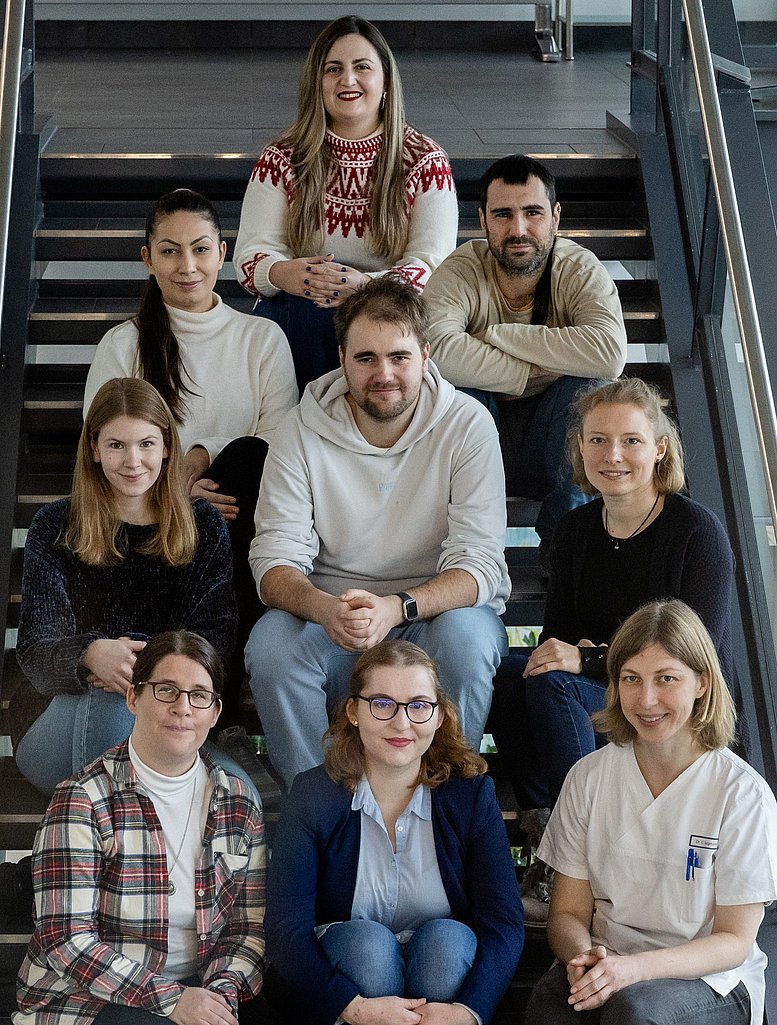
Head: Dr. med. Christina Bergmann
We study fibrosing diseases using systemic sclerosis (SSc) as a model disease. SSc is characterized by high morbidity and mortality and a variable disease course. We investigate:
- „Bedside“: Strategies to improve disease progression prediction and risk stratification in SSc.
- „Bench“: Mechanisms contributing to the maintenance of chronic fibrotic tissue response.
„Bedside“-Projects:
- Investigation of the molecular activity of fibrosing remodeling processes in SSc patients:
Pulmonary fibrosis is a common organ manifestation in SSc and is associated with an increased burden of disease. Although treatment strategies for pulmonary fibrosis have improved in recent years - through improved screening strategies - and expansion of the drug repertoire, management of the disease remains challenging. In particular, this is due to the variable nature of the disease and the difficulty in predicting the individual course of the disease. Fibroblast activation protein (FAP) is a protease that is increased in expression on activated fibroblasts. Recently, 68Ga-labeled FAP inhibitors have become available as PET tracers that selectively label active fibroblasts. In a first proof-of-concept study in cooperation with Prof. Kuwert and PD Dr. Schmidkonz (Nuclear Medicine Clinic), we demonstrated that 68Ga-FAPI-04-uptake is increased in patients with SSc-ILD and that marked 68Ga-FAPI-04 uptake is associated with short-term deterioration (Bergmann C*, Distler JHW*, et al., The Lancet Rheumatology 2021). In this project, we investigate the role of 68Ga-FAPI PET/CT as a potential prognostic factor for SSc-ILD and other fibrosing organ manifestations.
- European Sclerodermatrials and Research Group (EUSTAR) and Deutsches Netzwerk Systemische Sklerose (DNSS) Register:
We manage the Erlangen cohort of about 370 patients with systemic sclerosis and participate in the databases of the "European Scleroderma trials and Research Group" (EUSTAR) and the "Deutsches Netzwerk Systemische Sklerose" (DNSS). Participation in these projects allows us to collect prospective data to better understand the disease processes in systemic sclerosis and to link them to molecular biology studies. Here, we work on projects both within our center and in cooperation with other SSc centers.
„Bench“-Projects
- Mechanisms of chronic fibroblast activation.
Fibroblasts are the central effector cells in fibrosing diseases such as SSc. They differentiate into myofibroblasts, which are characterized by a high capacity to produce collagen and other connective tissue proteins. In contrast to the temporary activation of fibroblasts in wound healing processes, which is terminated after the repair process is completed, the fibrotic tissue response in systemic sclerosis initially remains active in an exuberant manner. Several mechanisms may be involved in this (Bergmann C, Distler JHW, et al., Epigenomics 2017; Dees C, et al., Exp Dermatol. 2021): on the one hand, direct, sustained stimulation by profibrotic signaling cascades, and on the other hand, epigenetic changes that occur as a result of stimulation with profibrotic signals. Our group is involved in projects that disentangle the network of profibrotic signaling cascades and mechanisms of epigenetic "reprogramming". Exemplary projects are described below:
- The role of X-linked inhibitor of apoptosis protein (XIAP) in systemic sclerosis (Bergmann C, et al., ARD 2021).
X-linked inhibitor of apoptosis protein (XIAP) is a member of the IAP family. XIAP is involved in many cellular processes of tissue turnover. In this project, we demonstrated that XIAP is increased in expression in the skin of SSc patients with diffuse, rapidly increasing skin fibrosis and is induced by TGFβ, a key fibrotic mediator. Inhibition of XIAP with pharmacological agents and mRNA-based knockdown results in attenuation of the fibrotic tissue response in several preclinical fibrosis models. These effects are at least partially regulated by the regulation of canonical WNT target genes. Thus, we demonstrated that XIAP represents a key switch point between two profibrotic signaling cascades, the TGFβ and WNT signaling pathways.
| Christina Bergmann | Junior Research group leader |
| Sara Chenguiti | Scientific doctoral student |
| Ziyuan Liu | Doctoral Researcher |
| Janina Auth | Clinician Scientist |
| Panagiotis Garantziotis | Clinician Scientist |
| Wolfgang Espach | Technician |
| Havva Nur Kartalczik | Assistent |
| Katrin Staudt | Medical Doctoral Researcher |
| Aslihan Öztas | Medical Doctoral Researcher |
| Katharina Thurau | Student Assistant |
| Paula Gehringer | Student Assistant |
Deutsche Forschungsgemeinschaft (DFG)
Singe application "The role of X-linked inhibitor of apoptosis protein (XIAP) in Systemic Sclerosis and other fibrosing disorders." (since 2020) - Dr. Christina Bergmann
ELAN-Program, Friedrich-Alexander University Erlangen-Nürnberg
"Interactions Hedgehog/AP1" (since 2021) - Dr. Christina Bergmann
"WNT5A" (2017) - Dr. Christina Bergmann
Clinician Scientists Programm, IZKF, Universitätsklinikum Erlangen
Clinician Scientist Rotation position 2021 - Dr. Christina Bergmann
Else Kröner-Fresenius-Stiftung (EKFS)
"Inhibition of Gli2"
Deutsche Stiftung Systemische Sklerose
Research Award 2017 (XIAP project) - Dr. Christina Bergmann
- Auth J, Müller F, Völkl S, Bayerl N, Distler JHW, Tur C, Raimondo MG, Chenguiti Fakhouri S, Atzinger A, Coppers B, Eckstein M, Liphardt AM, Bäuerle T, Tascilar K, Aigner M, Kretschmann S, Wirsching A, Taubmann J, Hagen M, Györfi AH, Kharboutli S, Krickau T, Dees C, Spörl S, Rothe T, Harrer T, Bozec A, Grieshaber-Bouyer R, Fuchs F, Kuwert T, Berking C, Horch RE, Uder M, Mackensen A, Schett G, Bergmann C. CD19- targeting CAR T-cell therapy in patients with diffuse systemic sclerosis: a case series. Lancet Rheumatol. 2025. doi: 10.1016/S2665-9913(24)00282-0.
Tur C, Eckstein M, Velden J, Rauber S, Bergmann C, Auth J, Bucci L, Corte G, Hagen M, Wirsching A, Grieshaber-Bouyer R, Reis P, Kittan N, Wacker J, Rius Rigau A, Ramming A, D'Agostino MA, Hartmann A, Müller F, Mackensen A, Bozec A, Schett G, Raimondo MG.
CD19-CAR T-cell therapy induces deep tissue depletion of B cells. Ann Rheum Dis. 2025. doi: 10.1136/ard-2024-226142.
- Bergmann C, Chenguiti Fakhouri S, Trinh-Minh T, Filla T, Rius Rigau A, Ekici AB, Merlevede B, Hallenberger L, Zhu H, Dees C, Matei AE, Auth J, Györfi AH, Zhou X, Rauber S, Bozec A, Dickel N, Liang C, Kunz M, Schett G, Distler JHW. Mutual Amplification of GLI2/Hedgehog and Transcription Factor JUN/AP-1 Signaling in Fibroblasts in Systemic Sclerosis: Potential Implications for Combined Therapies. Arthritis Rheumatol. 2025. doi: 10.1002/art.42979.
- Fakhouri SC, Zhu H, Li YN, Ronicke M, Rigau AR, Dees C, Konstantinidis L, Schmid R, Matei AE, Eckstein M, Geppert C, Ludolph I, Kreuter A, Sticherling M, Berking C, Horch RE, Schett G, Distler JHW, Bergmann C. Disturbed spatial WNT Activation- A Potential Driver of the Reticularized Skin Phenotype in Systemic Sclerosis. Arthritis Rheumatol. 2024. doi: 10.1002/art.43094.
- Müller F, Taubmann J, Bucci L, Wilhelm A, Bergmann C, Völkl S, Aigner M, Rothe T, Minopoulou I, Tur C, Knitza J, Kharboutli S, Kretschmann S, Vasova I, Spoerl S, Reimann H, Munoz L, Gerlach RG, Schäfer S, Grieshaber-Bouyer R, Korganow AS, Farge-Bancel D, Mougiakakos D, Bozec A, Winkler T, Krönke G, Mackensen A, Schett G. CD19 CAR T-Cell Therapy in Autoimmune Disease-A Case Series with Follow-up. N Engl J Med. 2024. doi: 10.1056/NEJMoa2308917.
- Bergmann C*, Müller F*, Distler JHW, Györfi AH, Völkl S, Aigner M, Kretschmann S, Reimann H, Harrer T, Bayerl N, Boeltz S, Wirsching A, Taubmann J, Rösler W, Spriewald B, Wacker J, Atzinger A, Uder M, Kuwert T, Mackensen A, Schett G. Treatment of a patient with severe systemic sclerosis (SSc) using CD19-targeted CAR-T-cells. Ann Rheum Dis. 2023. doi: 10.1136/ard-2023-223952.
- Treutlein C, Distler JHW, Tascilar K, Fakhouri SC, Györfi AH, Atzinger A, Matei AE, Dees C, Büttner-Herold M, Kuwert T, Prante O, Bäuerle T, Uder M, Schett G, Schmidkonz C#, Bergmann C#. Assessment of myocardial fibrosis in systemic sclerosis using [68Ga]Ga-FAPI- 04-PET-CT. Eur J Nucl Med Mol Imaging. 2023. doi: 10.1007/s00259-022-06081-4.
- Zhou X, Trinh-Minh T, Tran-Manh C, Gießl A, Bergmann C, Györfi AH, Schett G, Distler JHW. Impaired Mitochondrial Transcription Factor A Expression Promotes Mitochondrial Damage to Drive Fibroblast Activation and Fibrosis in Systemic Sclerosis. Arthritis Rheumatol. 2022. doi: 10.1002/art.42033.
- Bergmann C, Hallenberger L, Chenguiti Fakhouri S, Merlevede B, Brandt A, Dees C, Zhu H, Zehender A, Zhou X, Schwab A, Chen CW, Györfi AH, Matei AE, Chakraborty D, Trinh- Minh T, Rauber S, Coras R, Bozec A, Kreuter A, Ziemer M, Schett G, Distler JHW. X-linked inhibitor of apoptosis (XIAP) inhibition in systemic sclerosis (SSc). Ann Rheumatic Dis. 2021. doi: 10.1136/annrheumdis-2020-219822.
- Bergmann C*, Distler JHW*, Treutlein C, Tascilar K, Müller AT, Atzinger A, Matei AE, Knitza J, Györfi AH, Lück A, Dees C, Soare A, Ramming A, Schönau V, Distler O, Prante O, Ritt P, Götz TI, Köhner M, Cordes M, Bäuerle T, Kuwert T, Schett G, Schmidkonz C. ⁶⁸Ga- FAPI-04 PET-CT for molecular assessment of fibroblast activation and risk evaluation in systemic sclerosis-associated interstitial lung disease: a single-centre, pilot study. Lancet Rheumatol. 2021. doi: 10.1016/S2665-9913(20)30421-5.