Fibrosis research – From Bench to Bedside and Back – AG Bergmann, Advanced Clinician Scientist
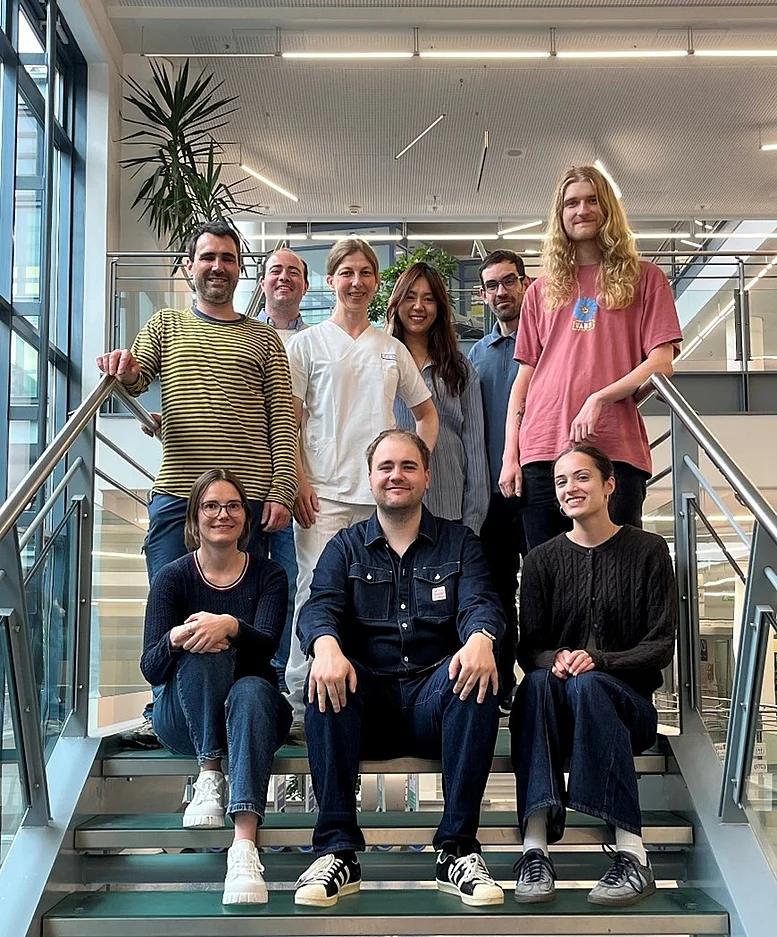
Head: Dr. med. habil. Christina Bergmann
We study immune-mediated fibrosing diseases using systemic sclerosis (SSc) as a model disease. SSc is characterized by high morbidity and mortality and a variable disease course. We investigate:
- „Bedside“: Strategies to improve disease progression prediction and risk stratification in SSc. Participation in clinical trials and patient registry studies in the field of systemic sclerosis.
- „Bench“: Mechanisms contributing to the initiation and maintenance of chronic fibrotic tissue response in immune-triggered diseases.
„Bedside“-Projects:
Clinical Studies in Systemic Sclerosis
In collaboration with our Clinical Trial Unit, we participate in international multicenter clinical trials in the field of systemic sclerosis, investigating both pharmacological therapies and novel treatment approaches such as deep B-cell depletion. In addition, we work on the definition and characterization of novel clinical study outcomes to actively contribute to the advancement of clinical trial methodology in systemic sclerosis (Bergmann C*, Suiyuan H*, […], Schett G, Khanna D, accepted manuscript).
Investigation of the molecular activity of fibrosing remodeling processes in SSc patients:
Pulmonary fibrosis is a common organ manifestation in SSc and is associated with an increased burden of disease. Although treatment strategies for pulmonary fibrosis have improved in recent years - through improved screening strategies - and expansion of the drug repertoire, management of the disease remains challenging. In particular, this is due to the variable nature of the disease and the difficulty in predicting the individual course of the disease. Fibroblast activation protein (FAP) is a protease that is increased in expression on activated fibroblasts. Recently, 68Ga-labeled FAP inhibitors have become available as PET tracers that selectively label active fibroblasts. In collaboration with Dr. Atzinger (Department of Nuclear Medicine), we are evaluating FAPI PET/CT as a diagnostic tool to improve individualized disease prediction and the assessment of fibrotic disease activity. In a first proof-of-concept study we demonstrated that 68Ga-FAPI-04-uptake is increased in patients with SSc-ILD and that marked 68Ga-FAPI-04 uptake is associated with short-term deterioration (Bergmann C*, Distler JHW*, et al., The Lancet Rheumatology 2021). The aim of an ongoing follow-up study is to validate these findings in a larger patient cohort with extended follow-up and to integrate FAPI PET/CT with established risk assessment tools in order to further improve individualized prediction of disease progression (see conference presentation OC38, World Scleroderma Conference, Athens, March 2026).
European Sclerodermatrials and Research Group (EUSTAR) and Deutsches Netzwerk Systemische Sklerose (DNSS) Register:
We manage the Erlangen cohort of about 370 patients with systemic sclerosis and participate in the databases of the "European Scleroderma trials and Research Group" (EUSTAR) and the "Deutsches Netzwerk Systemische Sklerose" (DNSS). Participation in these projects allows us to collect prospective data to better understand the disease processes in systemic sclerosis and to link them to molecular biology studies. Here, we work on projects both within our center and in cooperation with other SSc centers.
„Bench“-Projects
Mechanisms of chronic fibroblast activation.
Fibroblasts are the central effector cells in fibrosing diseases such as SSc. They differentiate into myofibroblasts, which are characterized by a high capacity to produce collagen and other connective tissue proteins. In contrast to the temporary activation of fibroblasts in wound healing processes, which is terminated after the repair process is completed, the fibrotic tissue response in systemic sclerosis initially remains active in an exuberant manner. Several mechanisms may be involved in this (Bergmann C, Distler JHW, et al., Epigenomics 2017; Dees C, et al., Exp Dermatol. 2021): on the one hand, direct, sustained stimulation by profibrotic signaling cascades, and on the other hand, epigenetic changes that occur as a result of stimulation with profibrotic signals. Our group is involved in projects that disentangle the network of profibrotic signaling cascades and mechanisms of epigenetic "reprogramming". Exemplary projects are described below:
The role of X-linked inhibitor of apoptosis protein (XIAP) in systemic sclerosis (Bergmann C, et al., ARD 2021).
X-linked inhibitor of apoptosis protein (XIAP) is a member of the IAP family. XIAP is involved in many cellular processes of tissue turnover. In this project, we demonstrated that XIAP is increased in expression in the skin of SSc patients with diffuse, rapidly increasing skin fibrosis and is induced by TGFβ, a key fibrotic mediator. Inhibition of XIAP with pharmacological agents and mRNA-based knockdown results in attenuation of the fibrotic tissue response in several preclinical fibrosis models. These effects are at least partially regulated by the regulation of canonical WNT target genes. Thus, we demonstrated that XIAP represents a key switch point between two profibrotic signaling cascades, the TGFβ and WNT signaling pathways.
Mechanisms of Tissue Remodeling in Immune-Mediated Fibrotic Connective Tissue Diseases
Initial case series and results from Phase I/II clinical trials suggest beneficial clinical effects of deep B-cell depletion, for example through CD19 CAR T-cell therapy, in patients with systemic sclerosis (J. Auth, F. Mueller […] Bergmann C, The Lancet Rheumatology, 2024; Müller, Hagen, […] Schett G, Nature Medicine, 2026). In this project, we investigate the tissue-level changes underlying these clinical improvements. In an initial study published in Nature Communications (May 2026) (Rius Rigau A, […], Yi Nan-Li, Bergmann C, Nature Communications), we demonstrated that CD19 CAR T-cell therapy induces partial regeneration of skin architecture, including restoration of dermal papillae and vascular structures. Furthermore, in vivo fibroblast activation, assessed by FAPI PET/CT imaging, was significantly reduced. In collaboration with colleagues at Düsseldorf University Hospital, we further demonstrated that the composition and functional profile of connective tissue cells, particularly fibroblasts, shift towards a physiological state following treatment. Our ongoing studies aim to identify the local immunological mechanisms that mediate this tissue response. As the durability of the therapeutic effects of CD19 CAR T-cell therapy varies between patients, another major objective is to characterize the factors that determine individual treatment responses. These projects are embedded within the Advanced Clinician Scientist Program iIMMUNE_ACS.
| Dr. med. habil. Christina Bergmann | Junior Research group leader |
| Ziyuan Liu | PhD candidate |
| David Koch | PhD candidate |
| Dr. Panagiotis Garantziotis | Clinician Scientist |
| Dr. Janina Auth | Clinician Scientist |
| Veronika Igl | Clinician Scientist |
| Dr. Andrea Zoli | Clinician Scientist/Research Fellow |
| Wolfgang Espach | Technician/Laboratory Management |
| Havva Nur Kartalczik | Research Assistant |
| Paula Gehringer | Research Assistant |
Deutsche Forschungsgemeinschaft (DFG)
Collaborative Research Centre 1755 (CASCAID)
Subproject 08: Mechanisms of CD19⁺ B Cells as Checkpoints of Tissue Remodeling in Autoimmune Diseases Using Systemic Sclerosis as a Model Disease (PI: Dr. med. habil. Christina Bergmann)
Research Grant
Reciprocal Amplification of Hedgehog and Activator Protein 1 (AP-1) Signaling in Systemic Sclerosis – Potential Therapeutic and Prognostic Implications(PI: Dr. med. habil. Christina Bergmann)
Steering Committee Member:
Networks of Tissue Responses in Inflammatory Diseases and Cancer (Clinician Scientist Programm: NOTICE - Clinician Scientist Programm Erlangen - Networks of Tissue Responses in Inflammatory Diseases and Cancer)
Federal Ministry of Research, Technology and Space (BMFTR): Advanced Clinician Scientist Program (iIMMUNE_ACS)
Project: Immune-driven tissue responses in autoimmune connective tissue disorders such as Systemic Sclerosis (Link: Our ACS Fellows - Deutsches Zentrum Immuntherapie | Uniklinikum Erlangen)
European Scleroderma Trials and Research Group
Database Improvement Grant (Link: www.eustar.org)
Previous Funding:
Deutsche Forschungsgemeinschaft (DFG)
Research Grant:The role of X-linked inhibitor of apoptosis protein (XIAP) in Systemic Sclerosis and other fibrosing disorders
ELAN-Program, Friedrich-Alexander Universität Erlangen-Nürnberg
- Interactions between Hedgehog and AP-1 Signaling (2021) – Dr. Christina Bergmann
- WNT5A (2017) – Dr. Christina Bergmann
Clinician Scientist Program, IZKF, Universitätsklinikum Erlangen
- Clinician Scientist Rotation Position (2021) – Dr. Christina Bergmann
- TOPeCS Mechanosensitive Ion Channels in Fibrotic Diseases
Deutsche Stiftung Systemische Sklerose
Research Award 2017 (XIAP Project) – Dr. Christina Bergmann
- Rius Rigau A*, Xu M*, Liu Z*, Chenguiti Fakhouri S*, Auth J, Garantziotis P, Zoli A, Selvaraju MK, Raimondo MG, Tur C, Filla T, Gehringer P, Eckstein M, Müller F, Atzinger A, Ronicke M, Ekici A, Schmid R, Wirsching A, Hagen M, Böltz S, Krickau T, Horch RE, Berking C, Grieshaber-Bouyer R, Ramming A, Gupta P, Bozec A, Mackensen A, Distler JH, Schett G, Li YN+, Bergmann C+. Deep phenotypoing of skin tissue remodeling in patients with systemic sclerosis treated with CD19-CAR T-cells. Nat Commun. 2026 May 23;17(1):4640. doi: 10.1038/s41467-026-72817-7.
Christina Bergmann*, Suiyuan Huang*, Janina Auth, Andreas Wirsching, Melanie Hagen, Soraya Kharboutli, Havva Nur Kartalcik, Michael Aigner, Sascha Kretschmann, Ricardo Grieshaber-Bouyer, Fabian Müller, Andreas Mackensen, Georg Schett and Dinesh Khanna. Trajectories of the EUSTAR activity Index, American College of Rheumatology Scleroderma Composite Index (ACR CRISS) and Revised CRISS in patients treated with CD19-CAR T-cells with diffuse cutaneous systemic sclerosis. Oxford Rheumatology, accepted manuscript.
Müller F, Hagen M, Wirsching A, Kharboutli S, Aigner M, Völkl S, Kretschmann S, Tascilar K, Taubmann J, Bucci L, Raimondo MG, Bergmann C, Rothe T, Corte G, Tur C, Muñoz L, Böltz S, Schuster L, Hartmann F, Garantziotis P, Spörl S, Vasova I, Gerbitz A, Spriewald B, Kiener H, Giannarelli D, Locatelli F, D'Agostino MA, Hanssens L, Miltenyi S, Bozec A, Grieshaber-Bouyer R, Mackensen A, Schett G. CD19 CAR-T cells for treatment-refractory autoimmune diseases: the phase ½ CASTLE basket trial. Nat Med. 2026 Mar;32(3):1142-1151. doi: 10.1038/s41591-025-04185-6. Epub 2026 Jan 7.
Petelytska L, Tofani L, Velauthapillai A, Dobrota R, Becker MO, Mihai C, Muraru S, Elhai M, Jordan S, Hachulla E, Müller-Ladner U, Siegert E, Allanore Y, Riemekasten G, Bergmann C, Becvar R, Solanki K, Anic B, Szabo I, Stamenkovic B, Distler J, Carreira PE, Cuomo G, Castellví I, Balbir-Gurman A, Airò P, Litinsky I, Saketkoo LA, Bertaccini B, Vonk MC, de Vries-Bouwstra J, Hoffmann-Vold AM, Matucci-Cerinic M, Distler O, Bruni C; EUSTAR collaborators. The incidence of interstitial lung disease in patients with systemic sclerosis: rate, risk factors and prognostic implications in a EUSTAR cohort analysis (CP133). Ann Rheum Dis. 2026 Apr;85(4):669-679. doi: 10.1016/j.ard.2025.12.008. Epub 2026 Jan 17.PMID: 41549016
- Auth J, Müller F, Völkl S, Bayerl N, Distler JHW, Tur C, Raimondo MG, Chenguiti Fakhouri S, Atzinger A, Coppers B, Eckstein M, Liphardt AM, Bäuerle T, Tascilar K, Aigner M, Kretschmann S, Wirsching A, Taubmann J, Hagen M, Györfi AH, Kharboutli S, Krickau T, Dees C, Spörl S, Rothe T, Harrer T, Bozec A, Grieshaber-Bouyer R, Fuchs F, Kuwert T, Berking C, Horch RE, Uder M, Mackensen A, Schett G, Bergmann C. CD19- targeting CAR T-cell therapy in patients with diffuse systemic sclerosis: a case series. Lancet Rheumatol. 2025. doi: 10.1016/S2665-9913(24)00282-0.
Tur C, Eckstein M, Velden J, Rauber S, Bergmann C, Auth J, Bucci L, Corte G, Hagen M, Wirsching A, Grieshaber-Bouyer R, Reis P, Kittan N, Wacker J, Rius Rigau A, Ramming A, D'Agostino MA, Hartmann A, Müller F, Mackensen A, Bozec A, Schett G, Raimondo MG.
CD19-CAR T-cell therapy induces deep tissue depletion of B cells. Ann Rheum Dis. 2025. doi: 10.1136/ard-2024-226142.
- Bergmann C, Chenguiti Fakhouri S, Trinh-Minh T, Filla T, Rius Rigau A, Ekici AB, Merlevede B, Hallenberger L, Zhu H, Dees C, Matei AE, Auth J, Györfi AH, Zhou X, Rauber S, Bozec A, Dickel N, Liang C, Kunz M, Schett G, Distler JHW. Mutual Amplification of GLI2/Hedgehog and Transcription Factor JUN/AP-1 Signaling in Fibroblasts in Systemic Sclerosis: Potential Implications for Combined Therapies. Arthritis Rheumatol. 2025. doi: 10.1002/art.42979.
- Fakhouri SC, Zhu H, Li YN, Ronicke M, Rigau AR, Dees C, Konstantinidis L, Schmid R, Matei AE, Eckstein M, Geppert C, Ludolph I, Kreuter A, Sticherling M, Berking C, Horch RE, Schett G, Distler JHW, Bergmann C. Disturbed spatial WNT Activation- A Potential Driver of the Reticularized Skin Phenotype in Systemic Sclerosis. Arthritis Rheumatol. 2024. doi: 10.1002/art.43094.
- Müller F, Taubmann J, Bucci L, Wilhelm A, Bergmann C, Völkl S, Aigner M, Rothe T, Minopoulou I, Tur C, Knitza J, Kharboutli S, Kretschmann S, Vasova I, Spoerl S, Reimann H, Munoz L, Gerlach RG, Schäfer S, Grieshaber-Bouyer R, Korganow AS, Farge-Bancel D, Mougiakakos D, Bozec A, Winkler T, Krönke G, Mackensen A, Schett G. CD19 CAR T-Cell Therapy in Autoimmune Disease-A Case Series with Follow-up. N Engl J Med. 2024. doi: 10.1056/NEJMoa2308917.
- Bergmann C*, Müller F*, Distler JHW, Györfi AH, Völkl S, Aigner M, Kretschmann S, Reimann H, Harrer T, Bayerl N, Boeltz S, Wirsching A, Taubmann J, Rösler W, Spriewald B, Wacker J, Atzinger A, Uder M, Kuwert T, Mackensen A, Schett G. Treatment of a patient with severe systemic sclerosis (SSc) using CD19-targeted CAR-T-cells. Ann Rheum Dis. 2023. doi: 10.1136/ard-2023-223952.
- Treutlein C, Distler JHW, Tascilar K, Fakhouri SC, Györfi AH, Atzinger A, Matei AE, Dees C, Büttner-Herold M, Kuwert T, Prante O, Bäuerle T, Uder M, Schett G, Schmidkonz C#, Bergmann C#. Assessment of myocardial fibrosis in systemic sclerosis using [68Ga]Ga-FAPI- 04-PET-CT. Eur J Nucl Med Mol Imaging. 2023. doi: 10.1007/s00259-022-06081-4.
- Zhou X, Trinh-Minh T, Tran-Manh C, Gießl A, Bergmann C, Györfi AH, Schett G, Distler JHW. Impaired Mitochondrial Transcription Factor A Expression Promotes Mitochondrial Damage to Drive Fibroblast Activation and Fibrosis in Systemic Sclerosis. Arthritis Rheumatol. 2022. doi: 10.1002/art.42033.
- Bergmann C, Hallenberger L, Chenguiti Fakhouri S, Merlevede B, Brandt A, Dees C, Zhu H, Zehender A, Zhou X, Schwab A, Chen CW, Györfi AH, Matei AE, Chakraborty D, Trinh- Minh T, Rauber S, Coras R, Bozec A, Kreuter A, Ziemer M, Schett G, Distler JHW. X-linked inhibitor of apoptosis (XIAP) inhibition in systemic sclerosis (SSc). Ann Rheumatic Dis. 2021. doi: 10.1136/annrheumdis-2020-219822.
- Bergmann C*, Distler JHW*, Treutlein C, Tascilar K, Müller AT, Atzinger A, Matei AE, Knitza J, Györfi AH, Lück A, Dees C, Soare A, Ramming A, Schönau V, Distler O, Prante O, Ritt P, Götz TI, Köhner M, Cordes M, Bäuerle T, Kuwert T, Schett G, Schmidkonz C. ⁶⁸Ga- FAPI-04 PET-CT for molecular assessment of fibroblast activation and risk evaluation in systemic sclerosis-associated interstitial lung disease: a single-centre, pilot study. Lancet Rheumatol. 2021. doi: 10.1016/S2665-9913(20)30421-5.